SSC CGL - Detailed Guide 2025
Self-Paced Course

State Government
Reference: Lucent GK, NCERT Class 6–12
1. Governor – Powers & Role
Articles 153 to 162
Nominal Executive Head of the State (Like President at Union level)
| Feature | Details |
|---|---|
| Appointment | By the President of India |
| Tenure | 5 years; holds office at the pleasure of the President |
| Eligibility | Indian citizen, ≥35 years, not hold office of profit |
| Oath | Administered by Chief Justice of the High Court |
| Dual Role | Constitutional Head of State & agent of the Centre |
Powers of the Governor:
Executive Powers
- Appoints Chief Minister, other ministers (on CM's advice), Advocate General, State Election Commissioner, etc.
- Appoints members of State Public Service Commission (SPSC)
Legislative Powers
- Summons, prorogues and dissolves State Legislature
- Addresses first session after general election and every year
- Nominates 1 Anglo-Indian to Legislative Assembly (if needed)
- Can reserve certain bills for President's assent
- Ordinance-making power under Article 213
Financial Powers
- Ensures State Budget is laid before Legislature
- Recommends Money Bills (like President at Centre)
Judicial Powers
- Appoints district judges in consultation with HC
- Can grant pardons, reprieves, etc. for offenses under state laws (Article 161)
Note: Governor has discretionary powers (especially in hung assembly situations, President's Rule recommendation, etc.)
2. Chief Minister & State Council of Ministers
Article 163 & 164
Chief Minister = Real Executive Head of the State
| Feature | Detail |
|---|---|
| Appointment | By Governor; leader of majority party in Vidhan Sabha |
| Tenure | Holds office as long as enjoys majority in Legislative Assembly |
| Role | Head of State Government, heads Council of Ministers |
| Advice | Real decision-maker; advises Governor on appointments, actions |
State Council of Ministers:
- Collective Responsibility: To State Legislative Assembly (Vidhan Sabha)
- Comprises: Cabinet Ministers, Ministers of State (with/without independent charge)
- Functions like Union Council of Ministers (Article 74-like model at State level)
CM = "Linchpin of State Administration"
3. State Legislature – Vidhan Sabha & Vidhan Parishad
Articles 168–212
Two Types of Legislatures:
- Unicameral: Only Legislative Assembly (most states)
- Bicameral: Legislative Assembly + Legislative Council (only in a few states like UP, Bihar, Maharashtra, Karnataka, Telangana)
A. Legislative Assembly (Vidhan Sabha)
| Feature | Details |
|---|---|
| Composition | 60–500 members (elected directly by the people) |
| Tenure | 5 years (unless dissolved earlier) |
| Presiding Officer | Speaker |
| Powers | Controls executive, passes budget, initiates Money Bills |
B. Legislative Council (Vidhan Parishad)
| Feature | Details |
|---|---|
| Composition | Permanent body; 1/3rd members retire every 2 years |
| Strength | Can't exceed 1/3rd of Assembly; not less than 40 |
| Election | Indirect (by MLAs, graduates, teachers, local bodies, Governor nomination) |
| Powers | Limited; can't reject Money Bill; only delay it by 14 days |
Note: Abolition or creation of Legislative Council – Article 169
(Requires Parliament's approval based on state legislature's resolution)
4. State Budget and Finance
State Budget → Annual financial statement under Article 202
| Component | Description |
|---|---|
| Presented by | Finance Minister of State (in Vidhan Sabha) |
| Approved by | State Legislative Assembly |
| Includes | Revenue Receipts & Expenditures, Capital Receipts & Expenditures |
Types of Bills:
- Money Bill: Can only be introduced in Vidhan Sabha with Governor's recommendation
- Financial Bill: Broader scope; deals with taxation & expenditure
- Vote on Account: Temporary provision if Budget isn't passed before fiscal year starts
Finance Commission:
- State Finance Commission under Article 243-I (for Panchayati Raj finance distribution)
- Central Finance Commission under Article 280 also allocates funds to states
Control on Expenditure:
CAG audits state government accounts → Report submitted to Governor → tabled in State Legislature
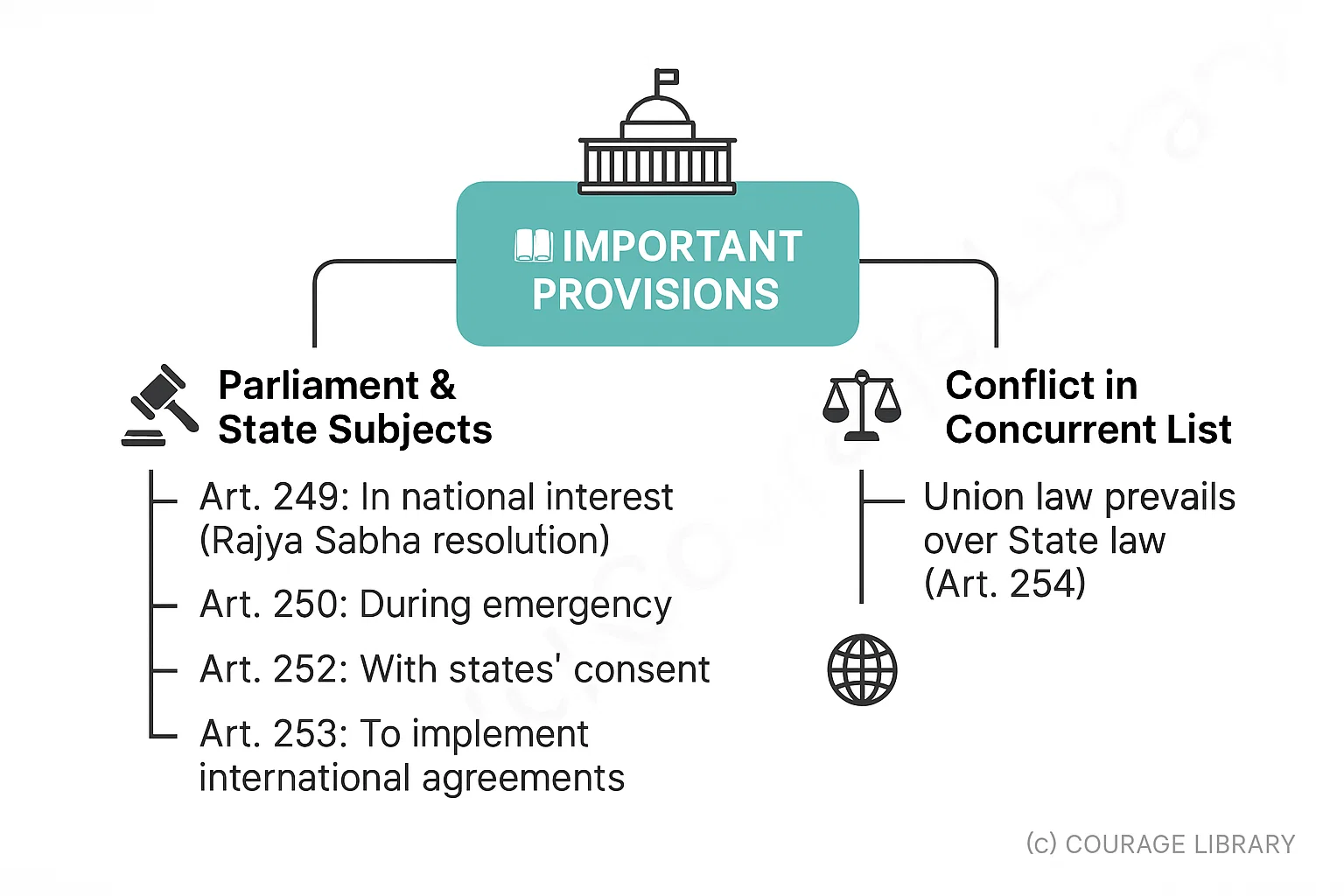
Important Provisions:
- Parliament can legislate on State subjects:
- In national interest (Art. 249 – Rajya Sabha resolution)
- During emergency (Art. 250)
- With states' consent (Art. 252)
- To implement international agreements (Art. 253)
- Conflict in Concurrent List: Union law prevails over State law (Art. 254)
Start Your SSC CGL Journey Now!
Join Courage Library to experience disciplined study and expert support.
Be a Couragian!